

STM History by Decade
1920s
Father T. Lawrason Riggs’s '10 was appointed by Yale University President James Rowland Angell as Yale’s first Catholic Chaplain on May 31, 1922. After a summer abroad, Fr. Riggs officially began his Catholic chaplaincy work in October 1922.
When Fr. Riggs started in October 1922, Yale had transformed significantly since his time as a student. The Catholic undergraduate population had grown from a handful in 1910 to 300 by 1922. His first semester saw the establishment of Yale’s Catholic Club, which drew 125 students to its first meeting. Riggs also began teaching classes on Catholicism and Medieval history at Dwight Hall, then Yale’s library.
Fr. Riggs immersed himself in campus life. His diary reveals a balance of intellectual and social engagement: teaching, attending concerts, lectures, football games, and events at Yale’s Elizabethan Club, Scroll & Key, and Mory’s. His home on Whitney Avenue served as a hub for Catholic students to gather, debate theology, and explore Catholicism, often over meals surrounded by his collection of rare books and art.
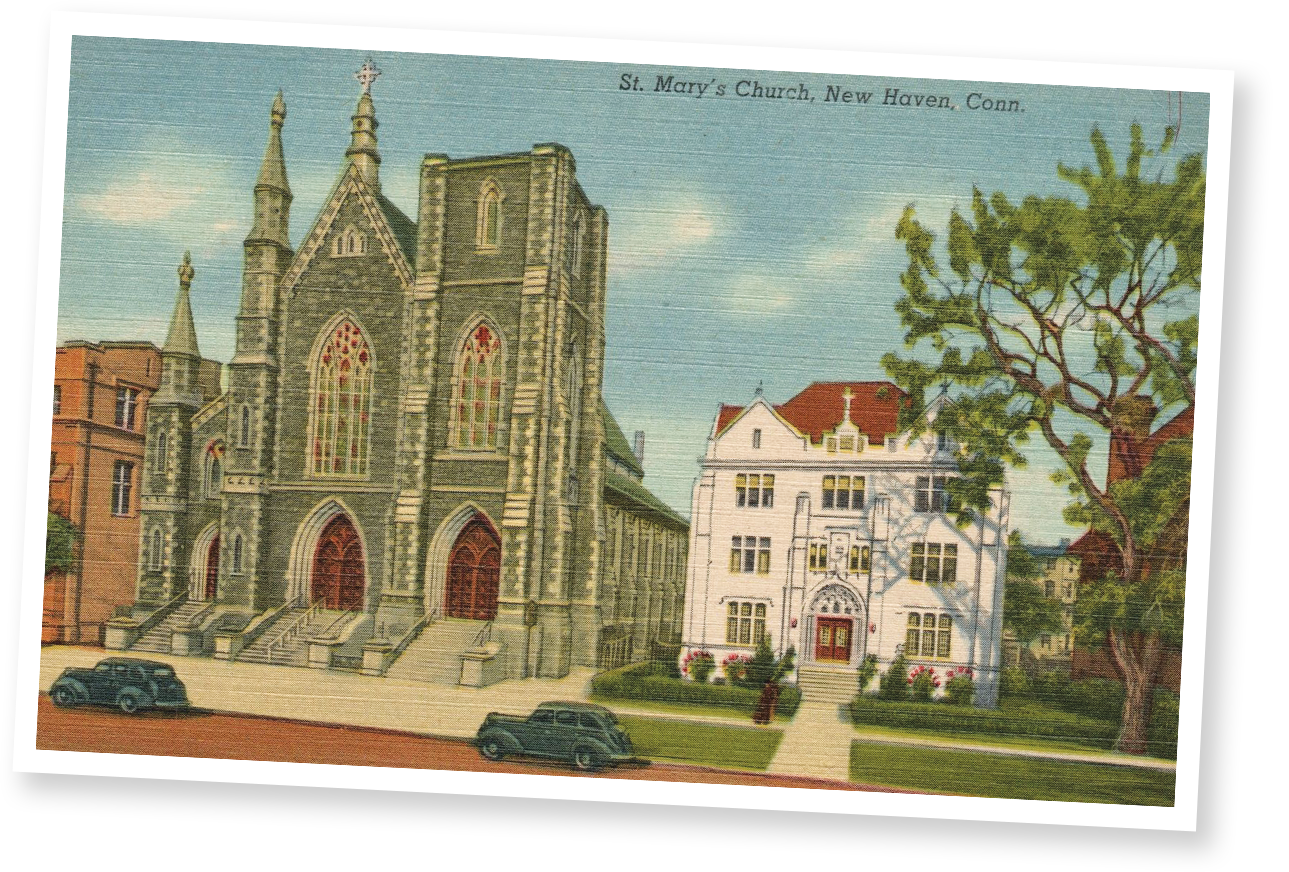
Through intellectual and social engagement, Riggs laid the foundation for Catholic life at Yale, a ministry that flourished and grew beyond his home, setting the stage for the future of the Catholic community on campus.
1930s and 1940s
In the 1930s, Fr. T. Lawrason Riggs ꞌ10 launched a campaign to build a Catholic chapel at Yale. He envisioned it as a “properly planned, attractively designed, and conveniently located” space to support daily Mass, Sunday worship, and broader engagement with Catholic students through study groups and lectures. By 1936, the New York Times announced the imminent construction of a chapel and clubhouse. Ground was broken on October 13, 1937, and the Chapel was completed in the summer of 1938.
Designed by William Douglas of William Douglas Orr & Associates, the Chapel’s Colonial Revival exterior harmonized with nearby Davenport and Pierson Colleges. Its Art Deco interior balanced tradition with modernity, reflecting Fr. Riggs’s vision of faith and secular studies informing each other. The Chapel was dedicated on October 9, 1938, in a ceremony presided over by Bishop Maurice F. McAuliffe, who left a strong impression on the many non-Catholics in attendance.
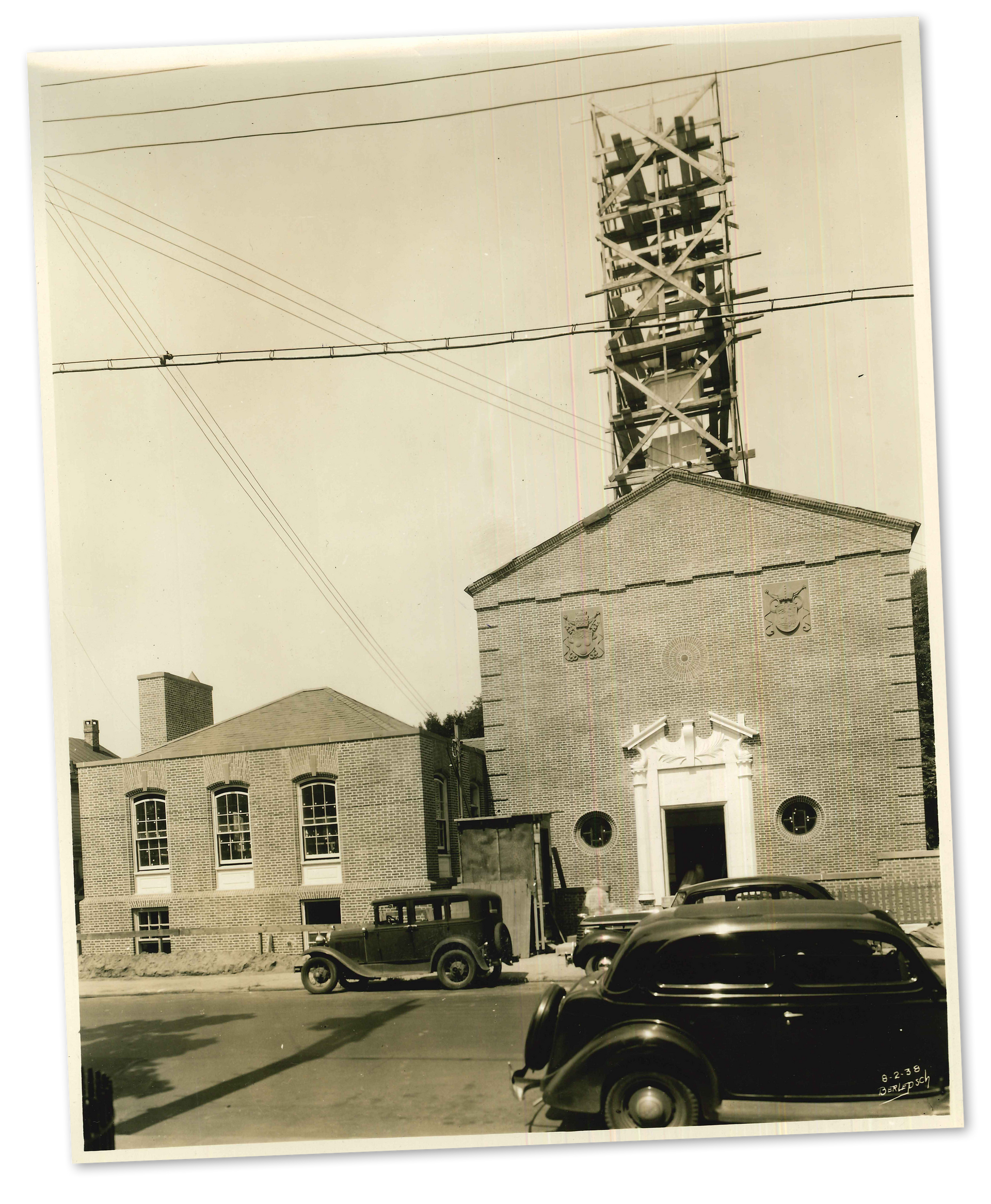
During World War II, the Chapel adapted to wartime needs. The boiler was converted to coal to meet rationing standards, and Fr. Riggs continued teaching religion courses until his sudden death on April 26, 1943 at the age of 56. He was succeeded by Fr. Edwin O’Brien ꞌ31, a former member of Yale’s Catholic Club.
With Yale hosting Army, Navy, and Marine cadets during the war, Fr. O’Brien was appointed Auxiliary Chaplain by the Military Ordinariate, and the Chapel opened its doors to servicemen. It began hosting dances for cadets and even celebrated marriages, with records filed at both St. Mary’s parish and the Military Ordinariate in New York.
Fr. O’Brien also oversaw the ornamentation of the Chapel, including etched windows created by Rambusch & Company of New York. Funded by alumni and parents—many grieving sons lost in the war—these windows became lasting tributes to Yale’s Catholic community and its servicemen.
1950s and 1960s
The 1950s marked a period of growth for STM, with Fr. Edwin O’Brien ꞌ31 describing it as “a vital factor in religious life at Yale.” In 1950, Yale invited him to teach two weeks on Catholicism in the course “Religion at the University,” marking the first time Catholicism was offered for academic credit at Yale. Catholic enrollment grew, with undergraduates increasing from 6.7% in the 1920s to 11.5% in the 1950s.
The first STM choir was formed in 1956 by Swiss student Johannes Somary, growing to 35 undergraduate members by the decade’s end. Catholic life revolved around Mass, small group lectures, the rosary, retreats, and social events with women’s colleges like Vassar and Smith.
In 1960, Fr. James Healy ꞌ49 became STM’s third chaplain. Beloved for his listening skills and openness to Vatican II reforms, Fr. Healy launched Yale Catholics Abroad for summer service in Mexico and established the More House Lecture series, beginning with Fr. John Courtney Murray’s “The Problem of God.” He also supported Yale’s appointment of Stephen Kuttner to the T. Lawrason Riggs Chair in Roman Catholic Studies in 1963, the first of its kind at a secular university.
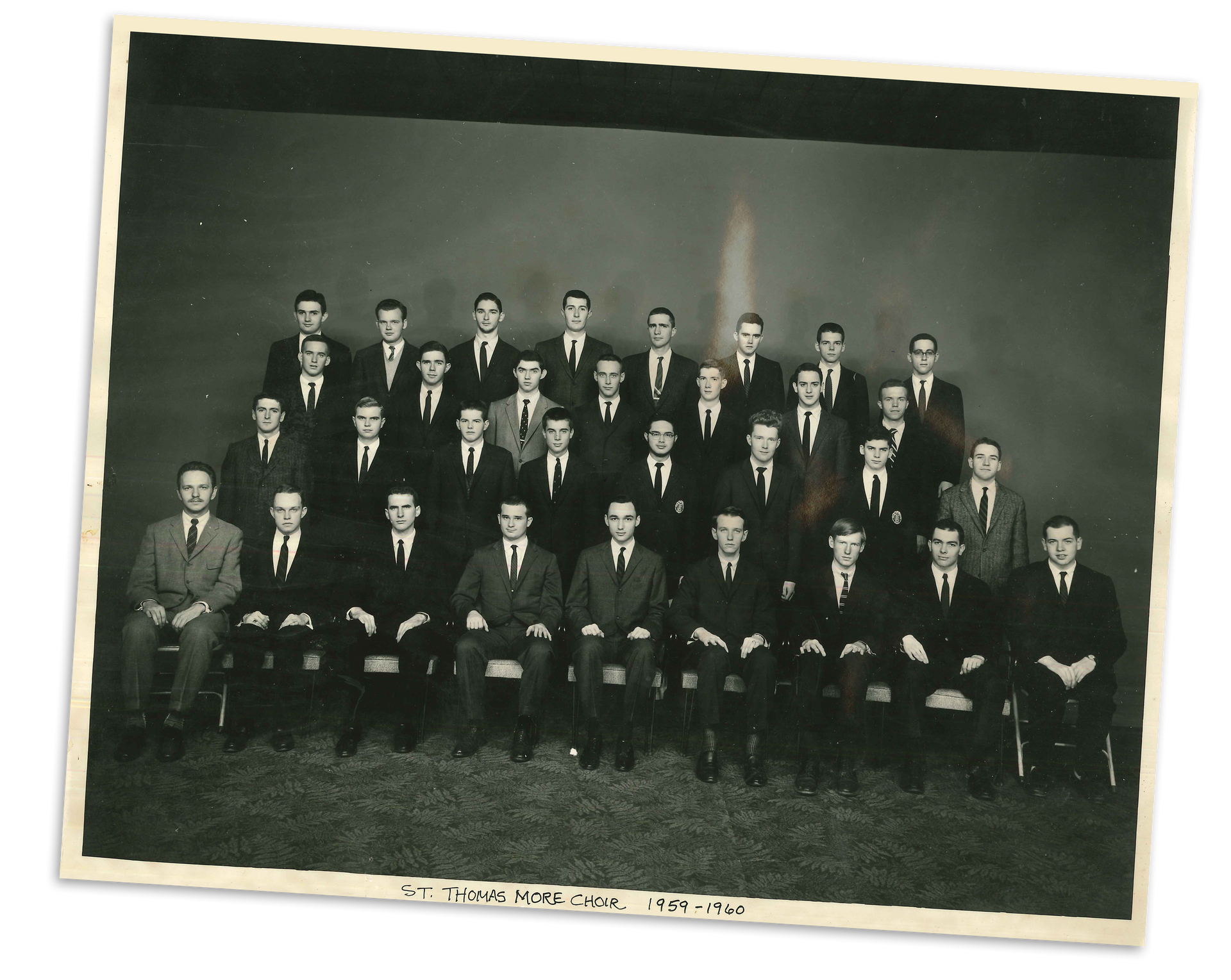
Fr. Healy left STM in 1966 for a sabbatical, and Fr. Richard Russell succeeded him as Acting Chaplain in 1968, continuing the legacy of Catholic intellectual and spiritual life at Yale.
Financial challenges arose in the mid-50s due to Chapel repairs and plans for a new wing. Fr. O’Brien introduced a subscription model for students to support Chapel upkeep, which proved successful. By 1957, the Chapel’s finances stabilized. Meanwhile, the Chapel saw significant enhancements, including the installation of two etched windows: one of the Venerable Bede in 1950 and another of Saints Damian and Cosmas in 1953. A new wing, designed by William Douglas, was completed by the early 1960s, fulfilling Fr. Riggs ꞌ10’s vision for a Catholic presence at Yale.
1970s and 1980s
The 1970s began a 25-year tenure for Fr. Richard Russell, STM’s fourth Catholic Chaplain. Appointed in 1968, Fr. Russell emphasized community, reflecting his belief that the Church should add a “community dimension” to student life. His tenure began as Yale became co-educational, and STM welcomed its first female Assistant Chaplain, Sister Mary Ramona Pena, C.S.J., to meet the needs of a growing Catholic community.
Programming and worship took place entirely in the Chapel, as the Golden Center had not yet been built. Students, both undergraduate and graduate, attended weekly folk Masses, shared brunches, and bonded over potlucks. Fr. Russell, who studied theology in Rome, was known for teaching students how to make spaghetti a la carbonara.
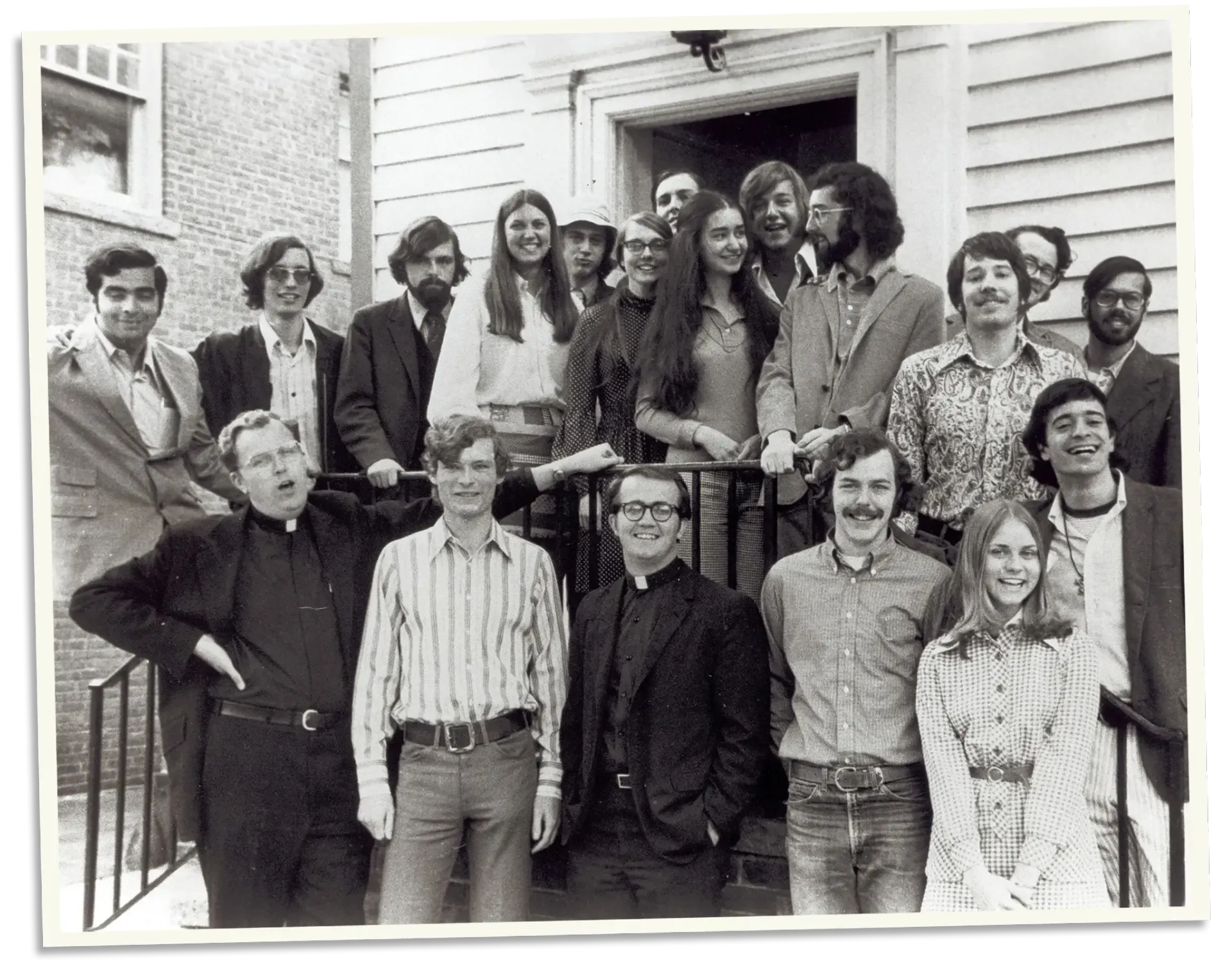
During Fr. Russell’s tenure, the White House was established as an intentional off-campus community for Catholic students to live, study, and grow in faith together. STM students also served the New Haven community, mentoring children and launching STM’s first religious education program for families.
Tragedy struck in 1977 when STM community member Richard Herrin murdered his girlfriend, Bonnie Garland. The community grappled with division over Sister Ramona’s ministry to Herrin during his trial. Herrin was convicted of manslaughter, serving 17 years.
In 1978, STM marked the quince-centennial of St. Thomas More’s birth and the Chapel’s 40th anniversary with a lecture series by Thomas M. C. Lawler. The 1980s saw students deepening their faith through Mass, retreats at Mercy by the Sea in Madison, CT, and hosting events like game nights and dramas, including the play Mass Appeal.
The Wednesday Soup Kitchen began in 1983, led by Professor Paul Kennedy. Volunteers served guests out of the Chapel basement, an initiative that continues to this day.
STM celebrated its 50th anniversary on October 2, 1988, with a special Mass. Fr. Russell retired in 1989, succeeded by Fr. Michael Gosselin as Yale’s fifth Catholic Chaplain
1990s and 2000s
Fr. David J. Baranowski became STM’s sixth Catholic Chaplain in 1992. During his tenure, he upheld traditions established by Fr. Russell, such as the fall opening picnic, and expanded outreach programs like the Wednesday Soup Kitchen and the Katherine Brennan Friendship Program, where Yale students mentored local elementary school children. Alumna Marie Colbert ꞌ95 recalled playing cards, visiting museums, and sharing meals with her mentee, who even attended her graduation.
Faith formation remained central, with retreats, Bible studies, and spiritual counseling offered to students. Fr. Baranowski left in 1994, succeeded by Fr. Robert Beloin, affectionately known as "Fr. Bob," whose nearly 25-year tenure transformed Catholic life at Yale.
Under Fr. Bob, STM expanded intellectually and physically. The 2000s saw the creation of named lecture series like The Judge Guido Calabresi Fellowship in Religion & Law and a 2003 conference addressing the Church’s sex abuse crisis, later published by Bloomsbury Academic.
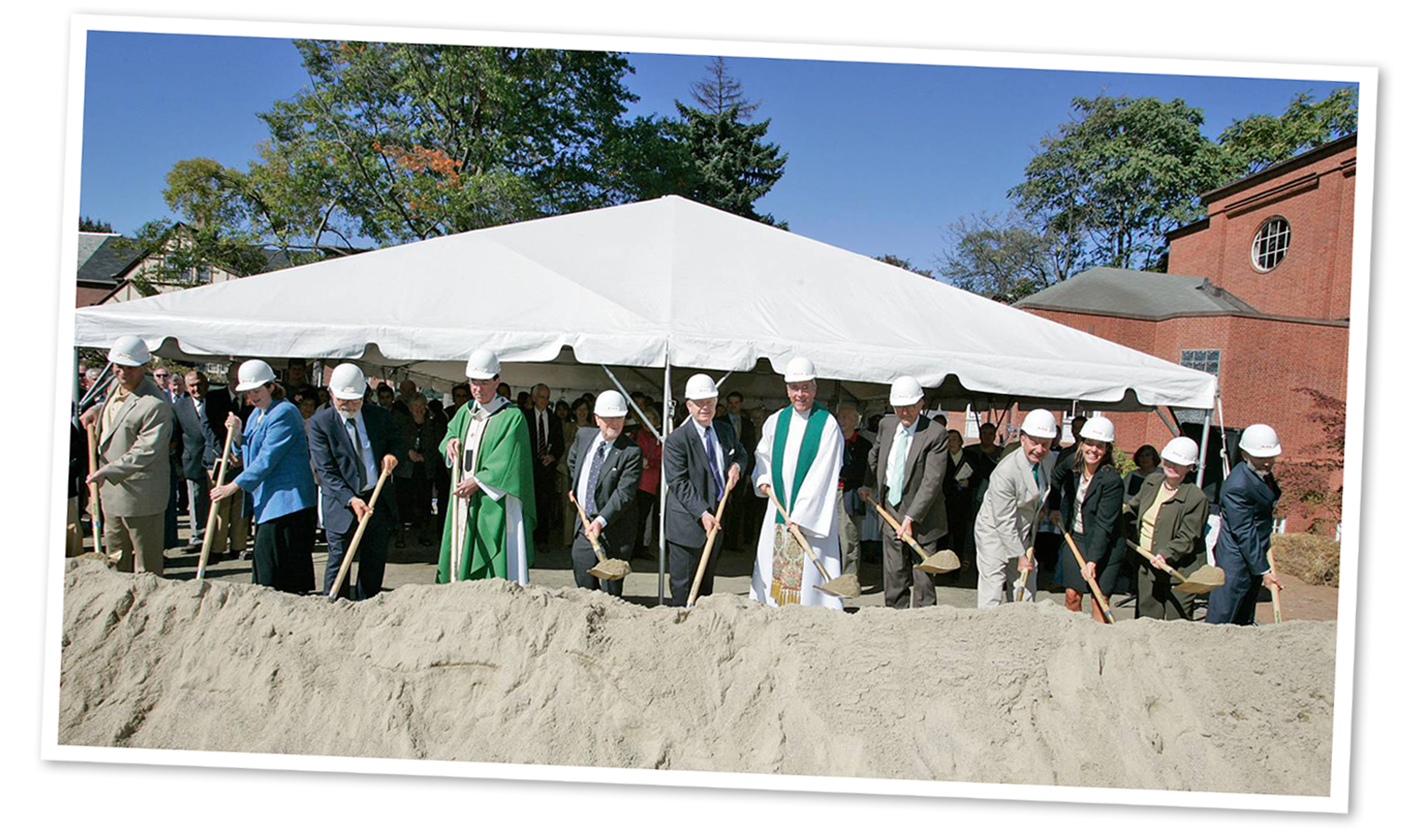
A major achievement was the construction of the Thomas E. Golden, Jr. Center, designed by renowned architect Cesar Pelli. Funded largely by a $25 million pledge from Thomas E. Golden, Jr. ꞌ51 B.E. ꞌ52 M.Eng., the center opened in 2006 as a welcoming space for students and the community. Guido Calabresi ꞌ53 ꞌ58 LL.B. and others played key roles in its completion.
In 2008, STM partnered with Leadership Roundtable to launch ESTEEM, a leadership formation program for young adult Catholics that now serves campuses across the U.S. The Chapel also underwent renovations in 2010, including the addition of a full-immersion baptismal font designed by STM member George Knight.
Fr. Bob’s legacy extended to his leadership and care. Diagnosed with glioblastoma in 2018, he was lovingly supported by the STM community until his passing on September 23, 2018. He is buried in Riggs Garden, near STM’s first Chaplain, Fr. T. Lawrason Riggs ꞌ10, symbolizing their enduring impact on Catholic life at Yale.